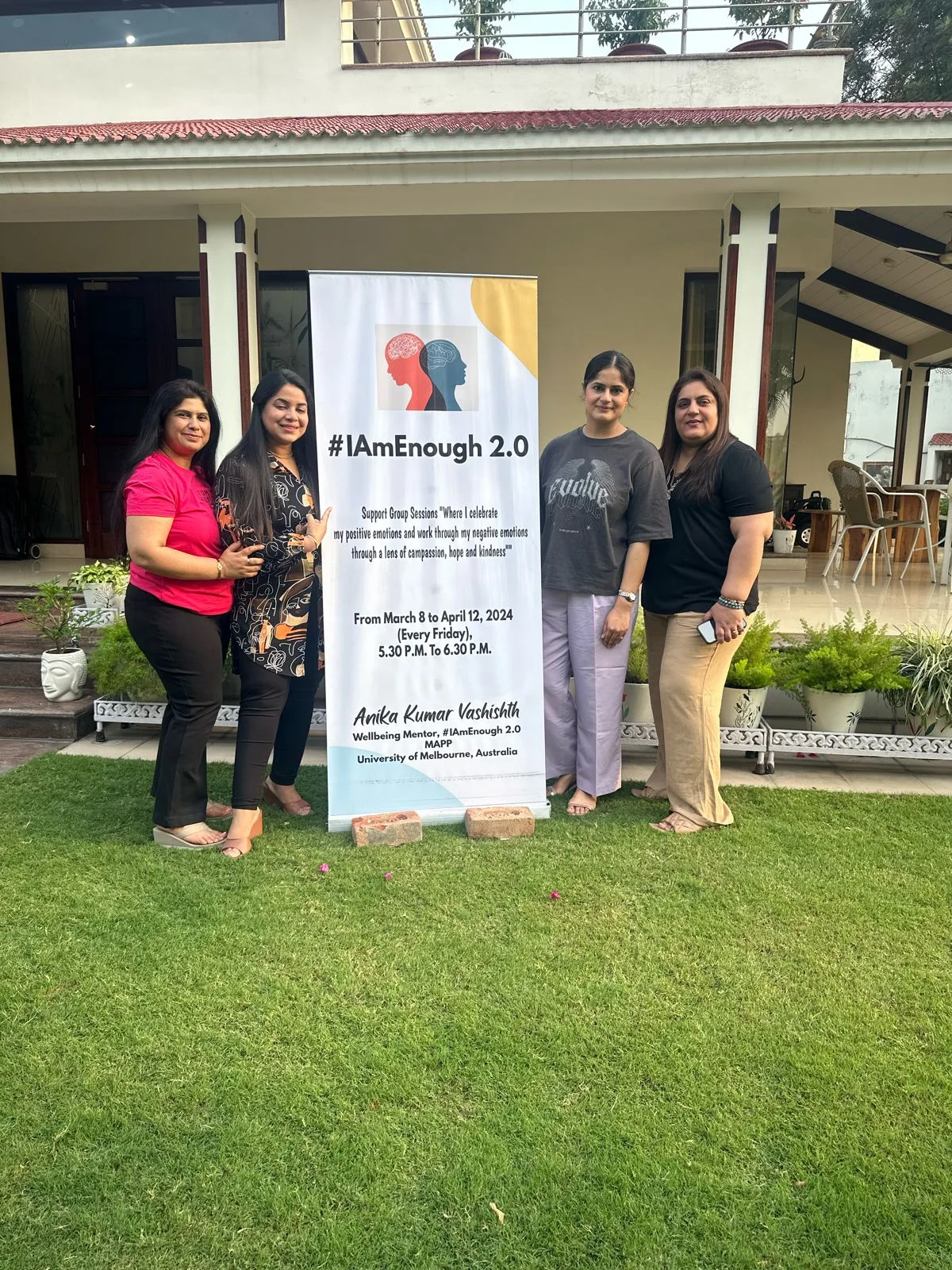



You may be functioning at work, caring for your family and managing everyday responsibilities — but still feel overwhelmed, stuck, anxious, self-doubting or disconnected from yourself.
You may be:
- Overthinking
- Struggling with everyday stress
- Experiencing work or relationship challenges
- Feeling stuck or directionless
- Struggling with confidence or self-doubt
- Facing a difficult decision
- Going through a life transition
- Looking for greater clarity
- Feeling that you are capable of more but don't know how to move forward
- Functioning, but not really flourishing

There is an important space between having a mental health condition that requires clinical care and feeling completely fine.
Many people don't have a mental illness, but may still be languishing — feeling disconnected, unfulfilled, overwhelmed, stuck or lacking a sense of meaning and progress.
That matters too. And there is support for that.
My approach
One-to-one coaching integrates:
Positive Psychology + CBT-informed coaching + neuroscience + mindfulness + self-compassion
We explore the relationship between thoughts, emotions and behaviours, while also looking at strengths, values, meaning and possibility.
A key part of the work is exploring the mental models and beliefs through which you see yourself and your circumstances.
Sometimes, changing the way we understand something changes the choices we can see.
The process is:
Awareness → Understanding → Perspective → Choice → Action
The goal isn't to give you all the answers.
It is to help you become increasingly able to find your own.

What coaching is — and isn't
Coaching is different from therapy and psychiatric care.
Therapy and psychiatric care have important roles in the assessment, diagnosis and treatment of mental health conditions and psychological difficulties.
My coaching is focused on Wellbeing, personal growth, clarity, strengths, agency and forward movement.
The first session is also an opportunity to understand whether coaching is appropriate for you. If it appears that another form of professional support would be more suitable, I will be transparent about that.
Who is it for?
Teenagers from approximately 13–14 onwards and adults across different stages of life.